

About Alena Solutions
Alena Solutions is a US-based digital product studio headquartered in Los Angeles. Founded in 2016, the company partners with businesses to develop digital products, build custom software, improve user experiences, and drive digital transformation. Its expertise spans product strategy, eCommerce, software development, and data visualization, helping organizations turn complex business challenges into practical technology solutions.
As eCommerce businesses face frequent changes in competitor pricing, product availability, and promotional offers, gaining timely market insights becomes increasingly important. This project focused on addressing these challenges through an AI-powered competitor tracking solution designed to automate market monitoring, streamline competitive analysis, and support smarter pricing decisions.
Project Summary: Alena Solutions partnered with us on an AI-powered competitor tracking solution for eCommerce that addresses the challenges of monitoring competitor prices, stock availability, and promotions across thousands of products. The platform collects market data, matches competing products, and recommends actionable pricing adjustments. By bringing competitor insights, historical price trends, and automated alerts into a centralized dashboard, the solution helps eCommerce teams respond to market changes faster, make informed pricing decisions, and protect profit margins while supporting data accuracy and responsible data collection practices.
Project Challenges
Keeping competitor data current was a key challenge for the eCommerce use case. Manual checks across competitor websites can quickly become outdated, delaying responses to price changes, promotional offers, and other market developments. The solution needed a more efficient way to collect competitor information and surface relevant changes.
Product matching presented another challenge. Competing retailers often use different product names, model numbers, descriptions, images, and bundle configurations. Incorrect matches can distort price comparisons and lead to unreliable recommendations. The platform therefore needed a consistent approach to identifying equivalent products and flagging uncertain matches for review.
Visibility into competitor stock availability and promotions was also important. Discounts, delivery offers, and stock changes can affect a product’s competitive position. A centralized view of these signals could help users identify relevant market developments and evaluate potential pricing responses.
The solution also needed to support consistent pricing decisions. Configurable price floors, margin thresholds, and review workflows could help users evaluate recommendations without relinquishing managerial control over price changes.
Finally, the platform had to collect public competitor data responsibly, handle changing page layouts, and integrate with the existing eCommerce system. Secure data handling, access controls, and audit logs were essential. We also needed to establish clear approval workflows before enabling automated price updates. Meeting these requirements required a structured approach to AI integration challenges and a reliable enterprise AI security strategy.
Solutions and Impact
We began by defining the project requirements, relevant competitor data sources, priority product categories, and pricing constraints for the eCommerce use case. We established how the platform would account for minimum margins, supplier terms, and configurable price floors, creating a consistent foundation for market monitoring and pricing recommendations.
Next, we built an automated data collection layer. Crawlers monitor selected competitor pages and public listings at scheduled intervals. The system collects prices, stock status, delivery charges, ratings, and promotions. The collection process prioritizes official APIs and authorized data feeds where available. For permitted public pages, it applies appropriate request limits and avoids collecting personal data.
An AI extraction model handles many page layout changes, reducing manual fixes. Extracted prices undergo validation checks to identify missing or inconsistent values. Unusual price changes are held for review before influencing recommendations. We combined text analysis, image recognition, and attribute comparison to identify equivalent products. The model evaluates brand, model number, size, quantity, and appearance, then assigns a confidence score. Low-confidence matches enter a review queue to reduce incorrect price comparisons.
We consolidated these capabilities into a unified dashboard featuring market insights, product review queues, configurable margin limits, pricing recommendations, and alerts. The dashboard also tracked promotions, delivery offers, and competitor stock-outs to highlight market opportunities.
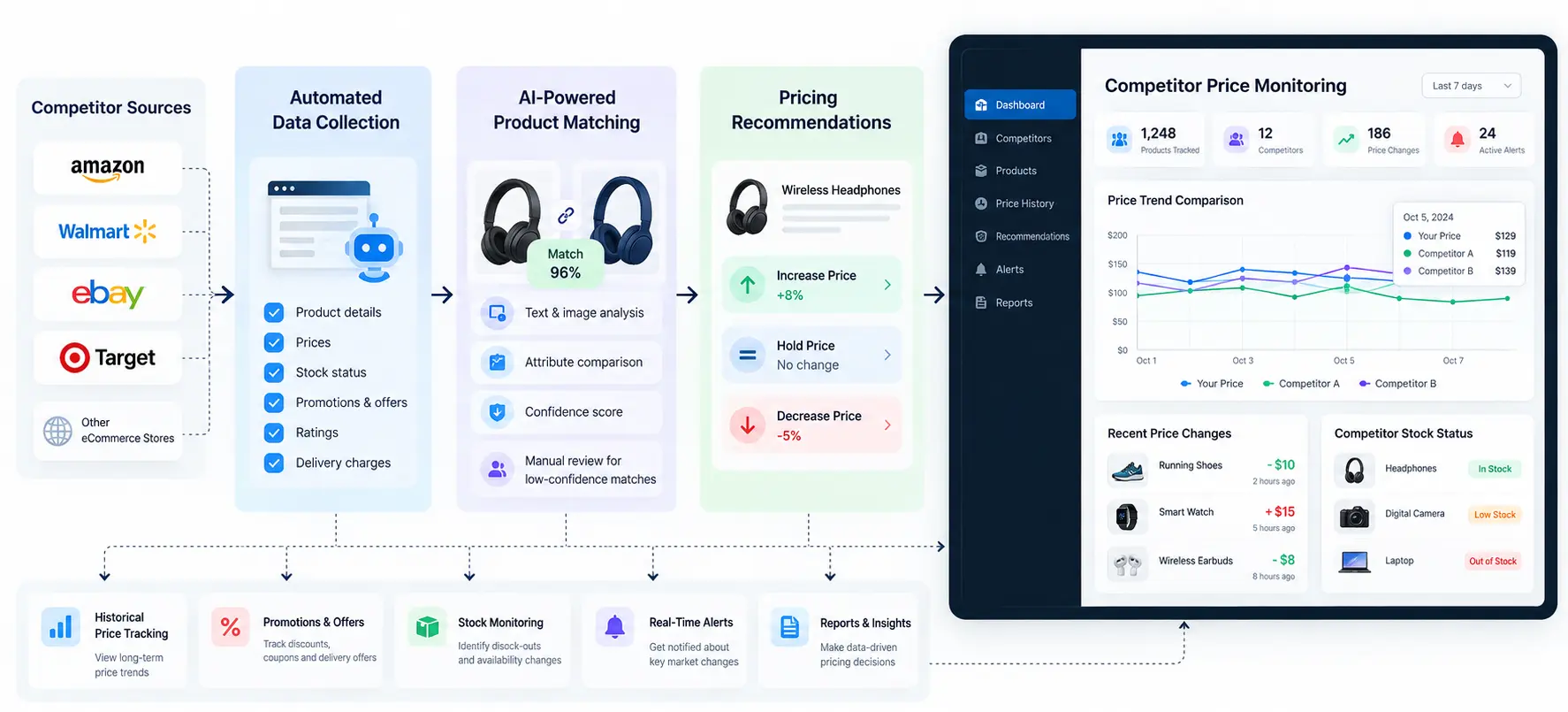
Our pricing recommendation engine analyzes sales history and competitor data to suggest price holds, adjustments, or increases. Each recommendation explains its rationale and estimated impact on margins and sales. Managers can approve, edit, or reject each recommendation before implementation. Our machine learning development approach helped bring these capabilities into one workflow. Email and Slack notifications alert the team when changes are detected, helping them respond within hours instead of days.
Before launch, we tested product matching against thousands of manually verified pairs. Pricing recommendations ran in advisory mode for several weeks, allowing the team to evaluate their usefulness. We then enabled automatic price updates gradually across selected categories, with pricing rules, approval controls, and audit logs supporting the rollout. The resulting platform combines AI development with practical pricing workflows, helping eCommerce teams monitor competitors, evaluate pricing opportunities, and maintain control over price changes
Technologies and Tools Used
Results
The platform was evaluated against the previous competitor-monitoring workflow for the eCommerce use case. The objective was to improve the timeliness of market insights, reduce manual research, and help users make more informed pricing decisions.
- Competitor prices refreshed every few hours instead of once or twice a week.
- Product matching reached 96% precision on confirmed matches, with uncertain matches sent for human review.
- Saved the pricing team 30 hours per week in manual work.
- Improved gross margins by 4.2 percentage points on monitored products.
- Increased online revenue by 13% in tracked categories.
- Reacted to competitor stock-outs and promotions 8 times faster, reducing response time from 4 days to under 12 hours.
Words of Appreciation
“WPWeb Infotech helped us replace manual competitor tracking with a reliable platform for market insights and pricing recommendations. Their team understood our needs, delivered accurate product matching, and gave us better visibility into competitor activity while keeping us in control of pricing decisions.”
Future Scalability
The platform can provide a flexible foundation for expanding competitor tracking and pricing intelligence as the eCommerce use case evolves. Potential enhancements include marketplace seller monitoring, competitor review analysis, customer sentiment insights, demand forecasting, and promotion planning.
Its modular architecture can support additional data sources, product categories, and sales channels as requirements grow. Product-matching and pricing models can also be refined using verified feedback and actual performance data. These improvements could help deliver more relevant market insights and support increasingly sophisticated eCommerce decisions.
As the product catalog and number of tracked competitors increase, the cloud-based infrastructure can scale to handle larger data volumes. The matching and pricing models can also improve through feedback from team decisions and actual sales results. Businesses can hire AI developers to extend these capabilities, integrate additional data sources, and refine pricing intelligence as their eCommerce operations evolve.