
Trusted by Clients Worldwide









What is LLM Fine-Tuning?
What is LLM Fine-Tuning?
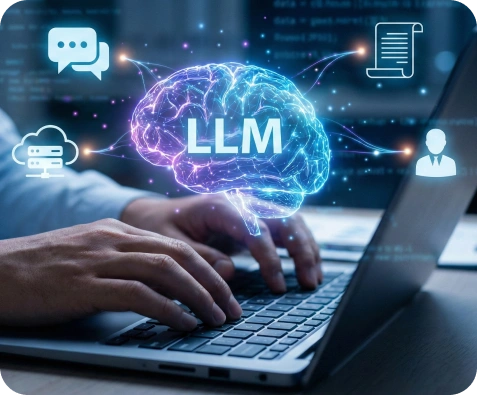
LLM fine-tuning is an advanced process of training a pre-trained Large Language Model with a domain-specific, structured dataset. LLM fine-tuning eliminates the need to rebuild the model from scratch by configuring a pre-trained model with business-specific data and use cases. Through targeted training, the model’s parameters are refined to recognize industry terminology, domain-specific patterns, and organizational requirements, resulting in more precise, contextually relevant, and consistent AI outputs.
LLM Fine-Tuning Services for Your Business
As a leading LLM fine-tuning company, we customize foundation models to your domain, datasets, and business requirements, from instruction tuning to domain-specific model adaptation and performance optimization.

Domain-Specific Model Adaptation
Our AI specialists adapt foundation models to domain-specific needs, improving their understanding of industry terminology, workflows, and specialized use cases while maintaining reliable performance.
- Industry-Specific Model Alignment
- Specialized Knowledge Integration
- Task-Oriented Optimization

Supervised Fine-Tuning (SFT)
Our AI developers fine-tune language models using high-quality, task-specific datasets to improve accuracy, consistency, and performance across targeted business applications.
- High-Quality Training Data
- Instruction & Response Optimization
- Task-Specific Performance

LLM Model Fine-Tuning Consultation
Our AI consultants provide end-to-end guidance on LLM fine-tuning strategies, helping businesses select the right models, datasets, techniques, and evaluation frameworks for their objectives.
- Model & Strategy Assessment
- Fine-Tuning Roadmap
- Performance Evaluation

Data Selection and Augmentation
Our AI experts curate, clean, structure, and augment training data to build reliable, high-quality datasets that improve model learning, generalization, accuracy, and domain relevance.
- Data Quality & Curation
- Synthetic Data Augmentation
- Dataset Structuring & Validation

LLM Model Fine-Tuning and Optimization
Our AI engineers optimise fine-tuned language models for accuracy, efficiency, scalability, and production readiness while balancing performance with operational costs.
- Hyperparameter Optimization
- Model Performance Tuning
- Cost & Inference Optimization

LLM Model Integration Services
Our AI developers integrate fine-tuned language models with existing systems and workflows for reliable performance, scalability and production-ready AI adoption.
- Application & API Integration
- Workflow & System Integration
- Production Deployment & Scaling
How Does LLM Fine-Tuning Benefit Business?

Proprietary Domain Knowledge
Fine-tuning adapts an LLM to your proprietary datasets, industry terminology, workflows, and specialized knowledge, enabling more relevant responses for your business-specific use cases.

Consistent Output Format
Our developers train models to follow predefined structures, tones, and response patterns, ensuring consistent outputs across customer interactions and other business workflows.

Faster Inference
A fine-tuned model can be optimized for specific tasks, reducing reliance on lengthy prompts and unnecessary context, which can help streamline inference and improve application responsiveness.

Efficient Prompts
LLM fine-tuning with high-quality, task-specific data improves response accuracy and consistency while reducing unsupported, inaccurate, or irrelevant outputs.

Behavioral Alignment & Safety
Our developers customize model behavior to follow your business guidelines, communication standards, and safety requirements, producing more predictable, policy-aligned responses.

Reduces Hallucinations
LLM fine-tuning with high-quality, task-specific data improves response accuracy, consistency, and relevance, helping reduce unsupported and inaccurate outputs across different use cases.
Our Engagement Models
Our LLM fine-tuning services are available through adaptable engagement options designed around your project scope, technical needs, and business goals. Select the right collaboration approach to turn your model requirements into production-ready, domain-specific, and optimized LLM solutions.

Fixed Price Model
Best-suited model for clearly defined LLM fine-tuning projects with a fixed scope, timeline, and deliverables. We create a structured roadmap and milestones, sharing predictable costs and an efficient path from integration to fine-tuning.

Time & Material Model
This model is ideal for evolving requirements, upgrades, troubleshooting, and ad-hoc integration needs. We offer flexible access to highly skilled AI developers and scaling support based on your project requirements.

Dedicated Team Model
The dedicated model covers every aspect of LLM fine-tuning and enterprise-grade transformation. Our dedicated AI developers collaborate closely with your team and provide continuous support across integration, optimization, and expansion.
Why Choose Us for LLM Fine-Tuning Services?
As an experienced LLM fine-tuning service provider, we help businesses transform general-purpose language models into specialized AI systems trained around their unique data, domain knowledge, and operational requirements. From dataset curation and preprocessing to training, evaluation, and deployment, we engineer customized LLMs that deliver reliable outputs, understand industry-specific contexts, streamline AI workflows, and support scalable business applications.
-
 Expertise in LLM Fine-Tuning
 -
End-to-End Implementation
-
 Advanced Fine-Tuning Techniques
 -
 Adaptive Hyperparameter Optimization
 -
 Precision Data Preprocessing
 -
Custom AI Model Development



Train Your Large Language Model With Our Highly Reliable Services
Best Practices & Strategies For LLM Fine-Tuning

Basic Hyperparameter Tuning
Our developers have a strong understanding of hyperparameter optimization, such as batch size and learning rate, which increases LLM efficiency and accuracy.

Multi-Task Learning
Our AI experts leverage multi-task learning, enabling Large Language Models to handle multiple functions simultaneously and facilitate cross-task adaptability.

Few-Shot Learning
At WPWeb Infotech, we use few-shot learning to optimize models by generalizing from minimal data, especially in data-scarce cases.

Task-Specific Fine-Tuning
We help businesses train LLMs for specific tasks by leveraging domain-specific datasets, regulatory constraints, and other specialized requirements.
Our LLM Fine-Tuning Success Stories
Explore our latest LLM fine-tuning projects, highlighting our expertise and commitment to high security.
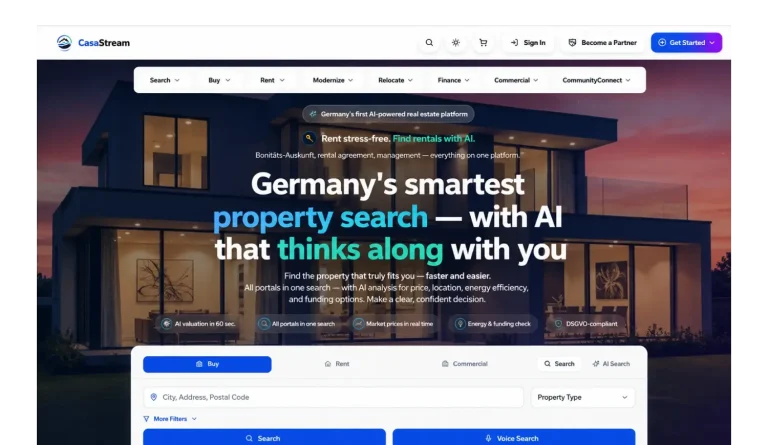
Our developers built an AI-powered platform and admin portal for a Germany-based real estate business. CasaStream offers an immersive property discovery experience with AI room staging, interactive price heatmaps, and AI-powered support. The platform enabled new revenue streams through integrated subscription management and service provider connections.
35%
Reduction in Development Time
40%
Increase in Multiple Subscriptions
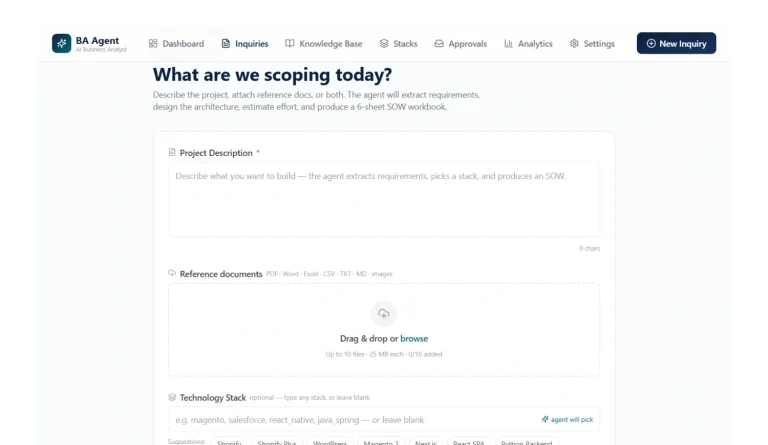
We built an in-house AI business analyst that converts project briefs into client-ready Scope of Work documents within minutes. It maps requirements, scopes web, mobile, and admin features, generates effort estimates, applies approved formatting, and delivers editable Excel and Google Sheet outputs compatible with any technology stack.
82%
Faster Scope of Work Preparation
100%
Blind-Spot Detection for Missing Features
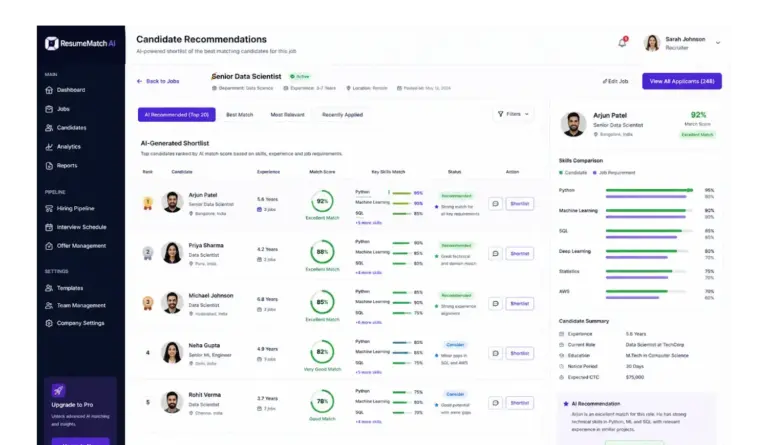
The client needed a faster way to review large numbers of resumes and identify suitable candidates. The challenge was handling different resume formats while improving matching accuracy and reducing manual screening. We developed AI-powered resume parsing, candidate ranking, automated shortlisting, and recruiter dashboards to simplify hiring workflows.
92%
Resume Parsing Accuracy
35%
Increase in Hiring Efficiency
Looking to Hire AI Experts for LLM Fine-Tuning Services?
Tech Stack We Use For LLM Model Optimization
AI Models
-

OpenAI GPT
-
Claude
-
Gemini
-
Llama
-
Mistral
-
DeepSeek


AI Platforms & APIs
-
OpenAI API
-
Anthropic API
-
Azure OpenAI
-
AWS Bedrock
-
Google Vertex AI
-
Hugging Face


AI Agents & Orchestration
-
LangGraph
-
LangChain
-
CrewAI
-
AutoGen
-
OpenAI Agents SDK
-
n8n


RAG & Vector Search
-
LlamaIndex
-
Pinecone
-
Qdrant
-
Weaviate
-
Chroma
-
FAISS


Model Training & Fine-tuning
-
OpenAI Fine-tuning
-
LoRA
-
QLoRA
-
PyTorch
-
TensorFlow
-
Scikit-learn


Multimodal AI
-
DALL·E
-
Stable Diffusion
-
Whisper
-
ElevenLabs
-
Runway
-
OpenCV


Backend & Databases
-
Python
-
FastAPI
-
Node.js
-
Laravel
-
PostgreSQL
-
MongoDB
-
Express.js


Cloud, DevOps & Security
-
AWS
-
Azure
-
Google Cloud
-
Docker
-
Kubernetes
-
OAuth


Our Model Alignment and Evaluation Services Workflow
Objectives & Use Case Discovery
We understand your business goals, use cases, expected outcomes, model requirements, and performance criteria to determine whether fine-tuning is the right approach. A detailed SOW establishes the scope, deliverables, milestones, and success criteria.
Training Data Preparation & Curation
We collect, clean, structure, and format relevant examples according to the selected model’s requirements. Low-quality, duplicate, or sensitive data is removed to create a reliable training dataset, with data preparation reviewed during key project milestones.
Model Selection & Fine-Tuning Strategy
Our AI specialists evaluate the right base LLM, training parameters, fine-tuning approach, and validation criteria based on your domain requirements. A formal project kick-off call aligns the team on the training strategy before model customization begins.
Model Training & Evaluation
The fine-tuning process is executed against curated datasets and evaluated using representative test cases, quality benchmarks, and defined business objectives. Demo calls at key milestones provide visibility into model behavior and help incorporate feedback into subsequent refinement cycles.
Integration, QA & Deployment
We integrate the fine-tuned model with your applications, APIs, workflows, databases, or other business systems. Structured QA validates model quality, reliability, security, and integration behavior, followed by staging validation and a final demo before production deployment.
Monitoring, Optimization & Maintenance
Industries We Transform With LLMs


Enhance Your LLM’s Accuracy With Our Fine-Tuning Services
What Our Clients Say About WPWeb Infotech
Our clients trust us for our deep expertise in LLM fine-tuning. Our AI experts have years of experience in training LLMs that scale efficiently with your business.


Trusted by 200+ happy clients

Frequently Asked Questions
What type of data do you need for LLM fine-tuning?
We work with high-quality, domain-specific datasets, including text documents, customer interactions, FAQs, instructions, product information, support conversations, and structured business data. Our team can also help curate, clean, format, and prepare datasets for effective model fine-tuning.
Do you offer post-deployment support and maintenance?
Yes, we provide ongoing support and maintenance after deployment, including model performance monitoring, evaluation, retraining, optimization, security updates, and dataset improvements to ensure consistent LLM performance.
How do your LLM fine-tuning services benefit my business?
Our LLM fine-tuning services help improve model accuracy, contextual understanding, response consistency, domain expertise, and task-specific performance while reducing the need for extensive prompting and manual intervention.
How much does it cost to fine-tune an LLM model?
The cost of LLM fine-tuning depends on the base model, dataset size, training complexity, customization requirements, compute resources, evaluation needs, and deployment environment. We provide a tailored estimate based on your specific project requirements.
How much training data do I need for fine-tuning?
The amount of training data varies by model, use case, task complexity, and desired performance. We assess your available data and recommend an appropriate dataset size and quality to achieve reliable fine-tuning results.
How long does a fine-tuning project take?
The timeline depends on factors including data preparation, model selection, fine-tuning approach, dataset size, evaluation requirements, and deployment scope. Our team defines a project timeline based on your specific customization and performance goals.
What is the main difference between fine-tuning and prompt engineering?
Prompt engineering improves model responses by optimizing the instructions provided to an existing LLM, while fine-tuning trains the model on specialized datasets to adapt its parameters to specific tasks, domains, or response patterns.
What models can be used for LLM fine-tuning & customization?
We can fine-tune and customize various open-source and supported proprietary LLMs, depending on their fine-tuning capabilities, licensing, APIs, and project requirements. Our team helps select suitable models based on your use case, data, performance objectives, and deployment environment.