
Client Overview
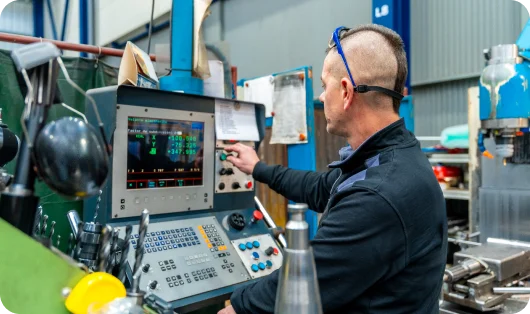
The client is a mid-sized precision metal components manufacturer in the US Midwest, serving customers in the automotive, agricultural equipment, and industrial machinery sectors. With approximately 650 employees across three plants and $210 million in annual revenue, its operations depend on CNC machines, hydraulic presses, pumps, motors, and conveyor lines running around the clock.
As production demands increased and delivery windows became tighter, unexpected equipment failures threatened production schedules. Monthly vibration inspections and fixed maintenance schedules often failed to identify developing faults early. The manufacturer needed a condition monitoring AI solution to monitor critical equipment continuously, predict potential failures, and help maintenance teams plan repairs without replacing the judgment of experienced reliability engineers.
Project Summary: The manufacturer needed a condition monitoring AI solution to reduce unplanned breakdowns and avoid unnecessary part replacements. We built a platform that collects vibration and temperature data from critical machines, uses machine learning to detect early faults, and predicts remaining useful life. It monitors equipment continuously, identifies developing issues, and provides repair recommendations through the existing maintenance system. Reliability engineers review and confirm critical alerts before action is taken.
Project Challenges
The first challenge was reducing unplanned downtime. Monthly vibration inspections often missed faults developing between checks. Bearing, motor, and gearbox failures could stop production lines, damage parts, and trigger costly emergency repairs. Fixed maintenance schedules also led to replacing components that still had useful life. The manufacturer needed a condition monitoring AI solution to identify developing faults early and help teams plan maintenance.
Another challenge was managing equipment data and limited technical expertise. Vibration readings were scattered across analyzer files and spreadsheets, with no connection to production schedules or repair history. Only two certified analysts supported all three plants. Fixed alarm thresholds also generated false alerts or missed early faults, reducing technicians’ trust in the monitoring process.
The solution also had to work across old and new equipment without disrupting production. Sensors needed to be installed without rewiring machines or stopping production lines. Alerts had to explain faults clearly and connect with existing maintenance workflows while protecting sensitive production data. Addressing these requirements involved careful AI integration planning and a reliable enterprise AI security approach to protect monitoring data and maintain secure system access.
Solutions and Impact
To close gaps between inspections, we deployed an ongoing condition-monitoring layer across critical production equipment. Wireless sensors on motors, pumps, gearboxes, and compressors capture scheduled high-resolution snapshots, while wired accelerometers on CNC spindles provide continuous, high-frequency data. Edge gateways process vibration signals using FFT and envelope analysis before securely sending data to the cloud. This setup enables early fault detection without modifying existing machine control wiring or stopping production.
To improve detection accuracy, we developed AI-powered condition monitoring software using machine-specific baselines. Machine learning models identify abnormal behavior across different operating speeds and loads, classify faults such as bearing defects, imbalance, misalignment, and looseness, and estimate remaining useful life. Each alert includes vibration spectra, trends, and baseline comparisons for engineering review. Claude on Amazon Bedrock converts alerts into plain-language summaries, retrieves relevant repair history, and drafts work orders with recommended steps and parts. It does not make equipment safety or maintenance decisions independently.
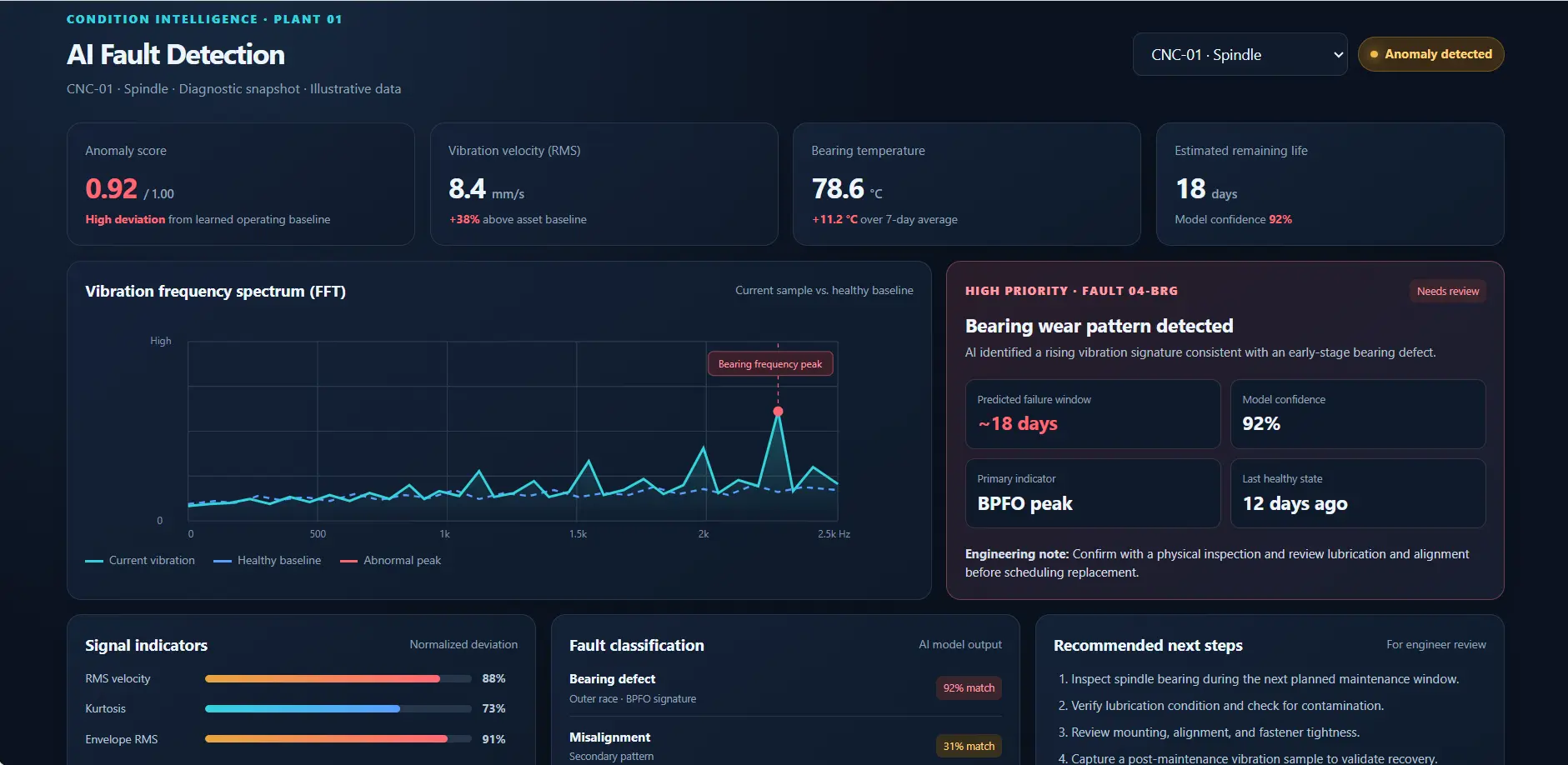
To connect monitoring with daily maintenance, we integrated the platform with the manufacturer’s CMMS. Confirmed alerts automatically generate work orders containing asset details, fault severity, and recommended actions. When technicians complete repairs, we store recorded findings and use them to retrain models on a regular schedule, validating each update before release. Role-based dashboards provide asset health overviews, prioritized repair schedules, and detailed diagnostics.
Our team worked as the manufacturer’s extended engineering team for seven months, from the initial pilot to deployment across all three plants. Our machine learning development services helped establish a scalable foundation for predictive maintenance, improving equipment reliability while helping maintenance teams plan repairs before failures disrupt production.
Technologies and Tools Used
Results
The condition monitoring AI platform transformed the manufacturer’s maintenance operations within six months of full rollout. By detecting equipment faults early, it helped teams plan repairs, reduce unexpected downtime, and make maintenance decisions with greater confidence.
Key Outcomes:
- Reduced unplanned downtime by 42%, saving approximately 1,900 production hours annually.
- Detected equipment faults an average of 18 days before failure.
- Reduced bearing and gearbox failures by 58%.
- Lowered maintenance costs by 21% through fewer emergency repairs and less overtime.
- Kept false alarms below 6%.
- Improved mean time to repair by 30%.
- Increased overall equipment effectiveness (OEE) by 4.5 points.
- Reduced route-based inspection time by 65%.
- Cut spare parts inventory by 14%.
- Reduced machine degradation-related scrap and rework by 18%.
- Achieved 92% coverage of critical assets within six months.
- Delivered an estimated project payback period of nine months.
Words of Appreciation
“We used to find out about a bad bearing when the line stopped. Now we hear about it weeks earlier, with the evidence in front of us, and we fix it during a planned shutdown. The WPWeb Infotech team took the time to understand how our plants actually run, and the system fits into our daily workflow. Our technicians trust the alerts because they can see why each one was raised. It has changed how we plan maintenance and how we talk to our customers about delivery.”
Future Scalability
The condition monitoring AI platform provides a scalable foundation for expanding predictive maintenance across the manufacturer’s operations. Future enhancements can extend monitoring to motor current and thermal imaging analysis, oil and lubrication condition monitoring, CNC tool wear detection, energy consumption analytics, and spare parts forecasting. The platform can also support maintenance planning based on production schedules, helping teams coordinate repairs with planned downtime. Its modular architecture allows new plants, equipment types, and system integrations to be added without rebuilding the existing solution.
As monitoring requirements grow, manufacturers can hire AI developers to enhance predictive models, integrate additional data sources, and develop new AI-powered maintenance capabilities. Ongoing model retraining using confirmed repair outcomes, sensor and gateway management, and accuracy monitoring will help maintain reliable predictions as data volumes increase. This will enable the manufacturer to improve equipment uptime, operational reliability, and maintenance efficiency over time.