
Client Overview
The client is a mid-sized Australian mobile and broadband provider serving consumer, small business, and wholesale customers through retail stores and digital channels. Its services include postpaid and prepaid mobile plans, NBN broadband, and business connectivity bundles. Over time, the company had adopted separate billing, CRM, network, and customer support systems, each generating its own reports.
As competition intensified and churn increased, leadership needed a unified view of subscriber, revenue, and network performance. The goal was to improve reporting consistency and support timely decisions without disrupting daily operations.
Project Summary: The client struggled with disconnected reports, inconsistent subscriber and monthly recurring revenue (MRR) figures, delayed churn identification, and late fraud detection. We developed a telecom business intelligence platform that unifies billing, call detail records (CDR), network events, and CRM data through real-time pipelines. The platform combines governed reporting, predictive analytics, and conversational access to help teams monitor performance and respond to emerging risks faster.
Project Challenges
The first challenge was fragmented data. Subscriber and revenue information was spread across billing, CRM, provisioning, and network systems, each with different identifiers and metric definitions. Even basic questions about active subscribers could produce conflicting answers. Analysts spent hours reconciling spreadsheets, while leadership lacked a reliable view of business performance. Integrating these systems required a clear approach to legacy system integration and consistent data definitions.
The second challenge was delayed analysis. High volumes of call detail records (CDRs) and network events were processed through overnight batch jobs, making it difficult to detect SIM swaps, international revenue share fraud, and Wangiri callback scams before losses occurred. Churn risks were also identified too late for retention teams to act, while marketing campaigns often relied on outdated data.
The third challenge was access and compliance. Report requests queued for weeks because only a small business intelligence (BI) team could build reports. The operator also needed to protect customer information under the Privacy Act 1988, the Australian Privacy Principles, and Part 13 of the Telecommunications Act 1997, while considering ACMA requirements and Telecommunications Industry Ombudsman (TIO) expectations for customer treatment. Keeping data in Australia and expanding analytics access without exposing sensitive information made enterprise AI security and controlled data access essential.
Solution and Impact
We built a centralized business intelligence platform for the telecom industry on AWS in the Sydney region, using Snowflake as the data warehouse. Apache Kafka handles streaming, while Airflow and dbt manage data orchestration and transformation across billing, call detail records (CDRs), network, and CRM systems. A master data management (MDM) layer unifies customer and service records, while the dbt Semantic Layer standardizes metrics such as active subscribers, monthly recurring revenue (MRR), average revenue per user (ARPU), and churn, giving every team a consistent view of performance.
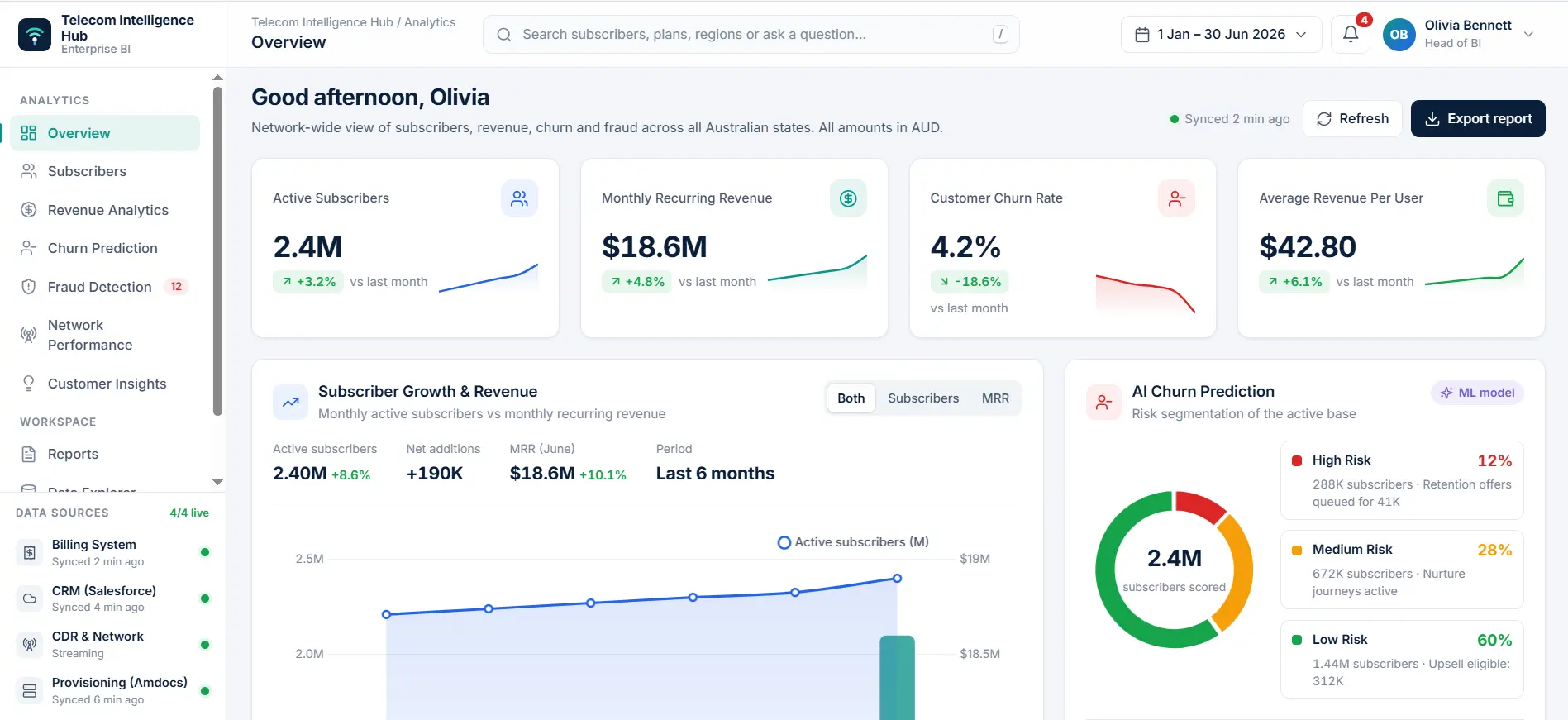
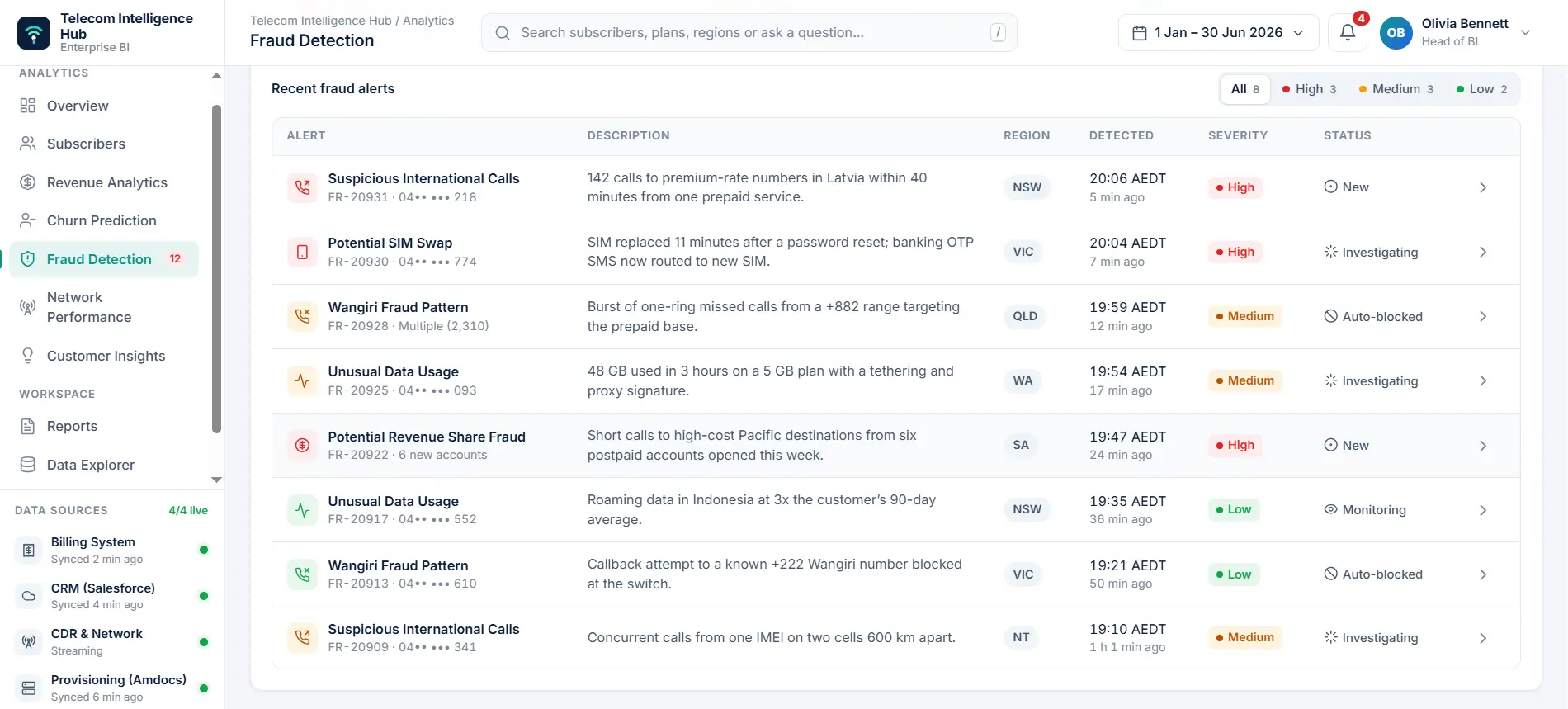
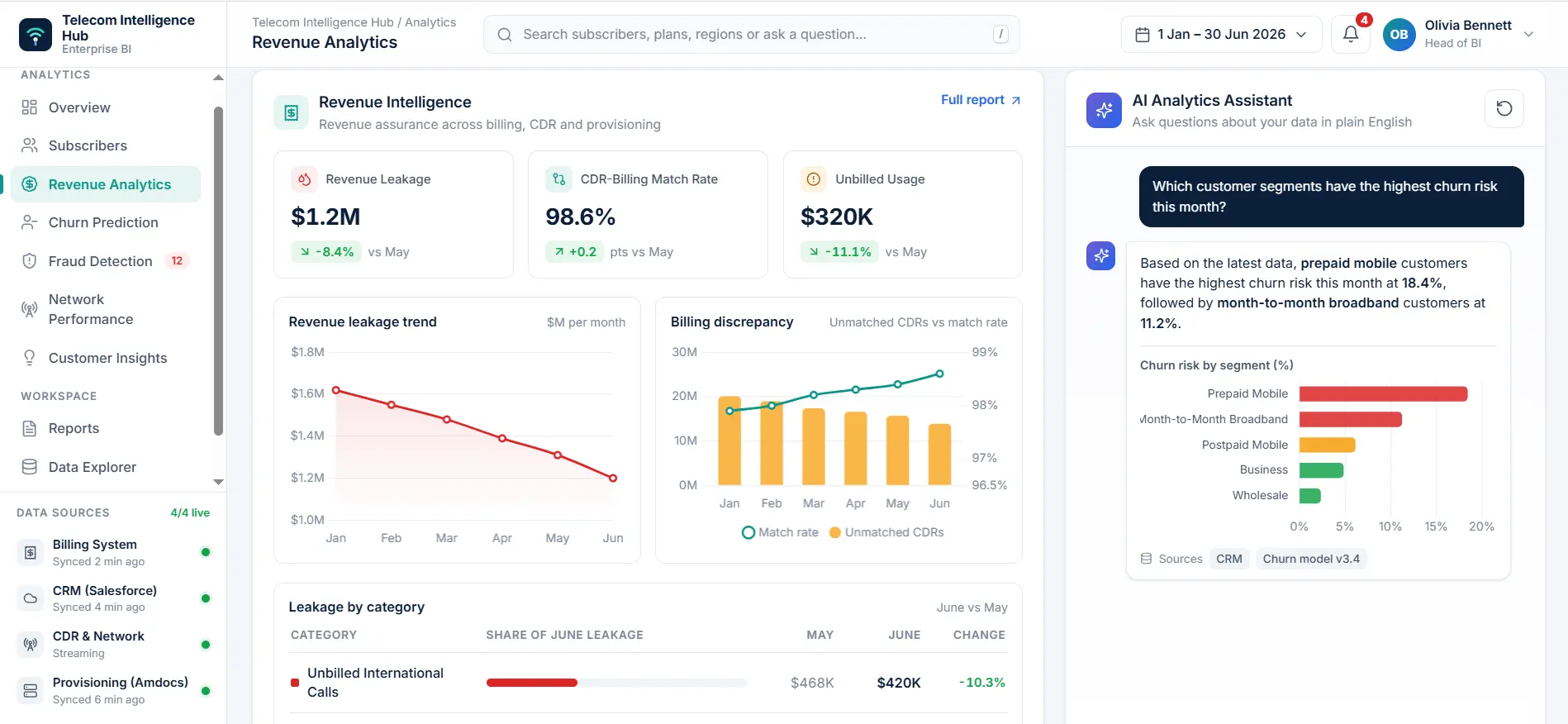
To accelerate decision-making, we developed real-time analytics pipelines and Power BI dashboards for revenue movements, plan mix, usage, and network quality. A churn prediction model identifies at-risk subscribers using usage patterns, billing issues, support contacts, and contract timing. Fraud models score streaming CDR and relevant network or account events through Amazon SageMaker endpoints, with results sent to Snowflake for reporting. The system flags suspicious international traffic, Wangiri callback patterns, and activity associated with potential SIM swaps, helping fraud teams investigate alerts within minutes. Our machine learning development services support building predictive models for these business needs.
We also introduced self-service BI and a conversational analytics assistant powered by Claude through Amazon Bedrock. Users can explore certified datasets or ask questions in plain English. The assistant queries the semantic layer, displays results with metric definitions, and avoids unsupported answers. The assistant executes queries using the authenticated user’s permissions, with the underlying data and query layers enforcing access controls and data masking. Audit logs support traceability, and data remains in Australian regions. Our team partnered with the operator’s data engineering function for eight months, supporting the project from discovery and pilot through full rollout.
Technologies and Tools Used
Results
Within six months of launch, the platform gave teams a consistent view of subscriber and revenue metrics, shortened report turnaround times, and helped fraud teams investigate suspicious activity sooner. Self-service analytics also reduced reliance on the central BI team for routine reporting.
Key Outcomes
- Unified subscriber and MRR reporting across finance, marketing, network, and customer care, replacing five conflicting reports.
- Reduced report turnaround time from 3 days to under 10 minutes.
- Reduced customer churn by 18%.
- Increased retention offer success rates by 27%.
- Reduced fraud-related revenue losses by 41% by detecting fraud within minutes instead of days.
- Reduced revenue leakage from billing errors and unbilled usage by 23% through automated CDR-to-billing reconciliation.
- Increased average revenue per user (ARPU) by 6% through better plan targeting and upsell timing.
- Improved network issue detection time by 50% by linking service quality dashboards to affected customers.
- Reduced the BI team backlog by 60% through self-service reporting and conversational analytics.
- Achieved 70% self-service analytics adoption among managers within four months of rollout.
Words of Appreciation
“The WPWeb Infotech team helped us bring our data together and turn it into actionable insights. Their understanding of telecom analytics, data integration, and reporting helped our teams identify issues sooner, make informed decisions, and work more efficiently. The collaborative approach and focus on data security made the implementation smooth and reliable.”
Future Scalability
As the operator grows, our team will continue to support pipeline monitoring, model retraining, data quality management, and updates to meet evolving privacy and telecommunications regulations. The platform’s modular architecture allows new capabilities, including network capacity forecasting, customer lifetime value modeling, 5G and IoT analytics, and automated anomaly detection, to be added without disrupting existing workflows.
To extend these capabilities, businesses can hire AI agent developers to build intelligent agents for customer service, sales, and operational analytics. Ongoing infrastructure scaling and model refinement will help the operator manage growing data volumes, improve customer retention, and identify revenue opportunities while maintaining reliable network performance.