Client Overview
The client is a sports performance and training company based in California, United States, with facilities offering baseball and softball training for youth, high school, and college athletes. It runs private lessons, group clinics, and seasonal camps, and works with more than 3,000 athletes every year. Coaches already filmed most sessions on phones and tablets, but rarely used the footage beyond a quick replay on the field.
Project Summary: Video is one of the best teaching tools in sports, but manual review takes time most coaches don’t have. We developed an AI-powered video analysis platform that studies an athlete’s movement from ordinary phone footage, measures key technique points, and returns simple feedback within minutes. It also builds highlight reels automatically and tracks progress over time. The challenge was delivering accurate analysis from imperfect video while protecting young athletes’ privacy.
Key Challenges
Video review was slow and manual. After a session, coaches replayed clips frame by frame, drew lines on the screen, and recorded voice notes. A single athlete could take 20 to 30 minutes to review properly, so most players received detailed feedback only once every few weeks, if at all.
Feedback also depended on the coach’s eye. Two coaches could describe the same swing or throw differently, and small details such as hip rotation, arm angle, or timing were easy to miss at full speed. Athletes and parents had no objective numbers to show whether a change in technique was actually working.
The footage itself was difficult to use. Clips came from different phones, angles, lighting conditions, and frame rates, and many were shot from a distance with players partly hidden behind equipment or teammates. Any tool that needed studio-quality cameras or special sensors would not work in a normal training facility.
Progress tracking was another gap. Videos were stored in shared folders and chat threads, so it was hard to compare an athlete’s mechanics from last month with today’s. Coaches kept notes in notebooks and spreadsheets, and families received updates in scattered messages.
At the same time, most clients were minors, so any solution had to protect video and personal data carefully. It needed parental consent controls, secure storage, and compliance with US privacy laws, including children’s privacy rules. It also had to be simple enough that coaches would actually use it between sessions on the field.
Our Solution
We began by observing training sessions and interviewing the client’s coaches, athletes, and parents. Together we listed the movements that mattered most, such as pitching, hitting, and throwing, and agreed on what a useful result looks like: a few clear measurements and one or two simple suggestions, not a long technical report.
Next, we built the video foundation. Footage uploaded from a phone or tablet is checked for quality, stabilized, and standardized, and the system warns the coach if a clip is too dark or the athlete is out of frame. Clips are stored securely and linked to each athlete’s profile, so every session adds to a continuous record.
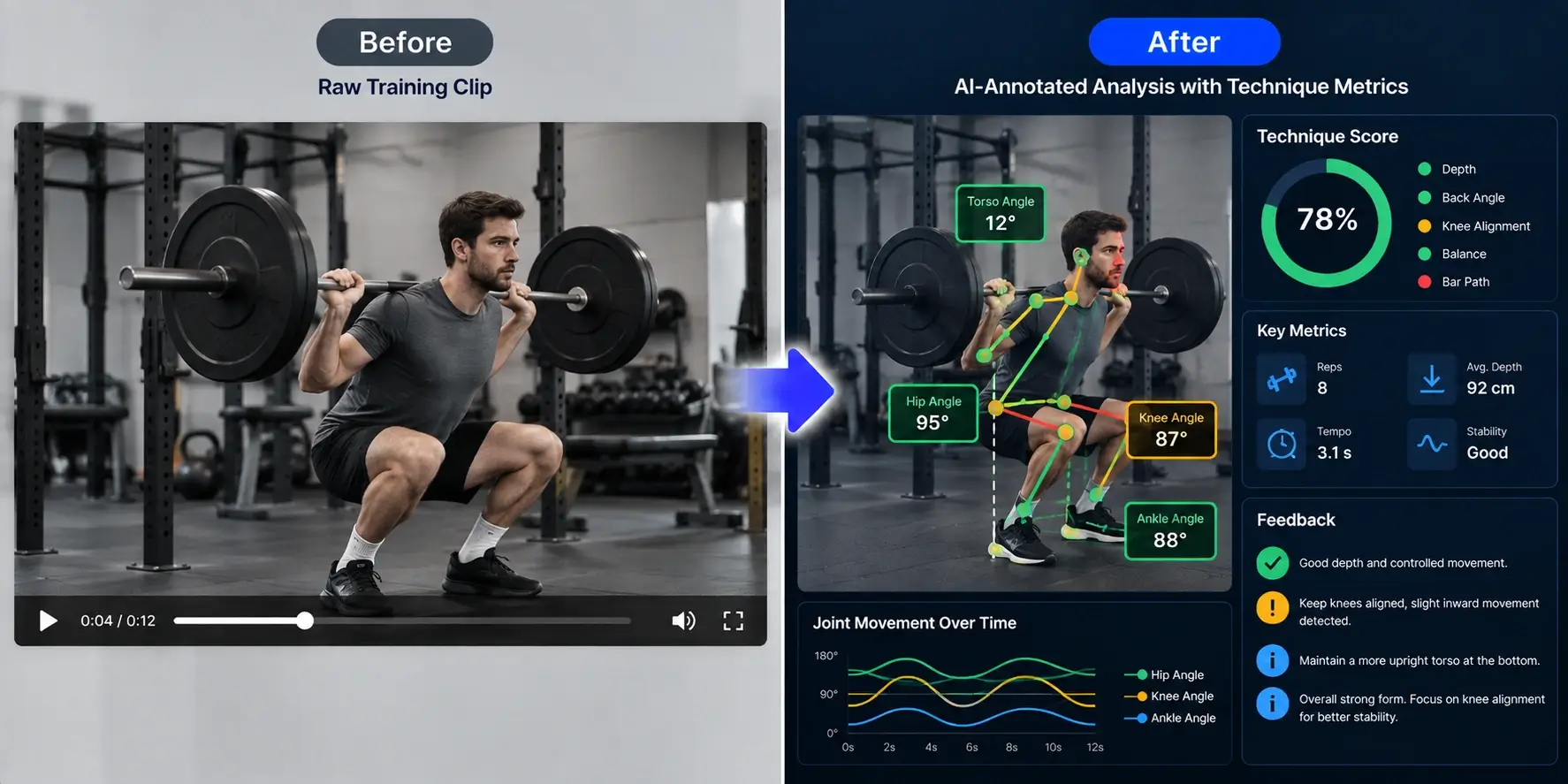
At the core is a pose estimation engine. It detects the athlete’s body joints in every frame and builds a moving skeleton, even when the camera angle is not perfect. The app guides coaches to film in slow motion (120 or 240 fps) from set side and front angles, which helps keep measurements consistent between sessions. From this, the platform measures technique points such as stride length, hip and shoulder rotation, arm slot, release point, and bat path, and shows them as simple overlays on the video.
To turn measurements into coaching, we added a technique scoring and feedback layer. We compare each movement with the athlete’s earlier attempts and coach-approved reference ranges for the athlete’s age and level. The platform highlights what changed and offers short suggestions, while the coach can accept, edit, or replace any comment before it reaches the athlete.
We also built an automatic highlight and clip engine. The system finds key moments, such as each pitch or swing, cuts them into short clips, and groups them by session. Coaches no longer scrub through an hour of footage, and athletes receive a clean reel that they can review or share with college recruiters, with parental approval.
For athletes and families, we created a mobile app with a personal progress view. It shows side-by-side comparisons of past and current mechanics, trend charts for key measurements, and drills assigned by the coach. Parents can see progress without accessing anyone else’s data.
Alongside the AI models, we built a coach dashboard so the team can manage everything without technical support. Configurable views and settings were created for elements such as:
- Athlete profiles and session library
- Technique metrics and reference ranges
- Highlight reels and sharing permissions
- Progress reports and drill assignments
This let each coach adapt the platform to their own teaching style while the AI handled the repetitive measuring and clipping.
Before full launch, the measurements were compared with manual coach analysis and with motion capture data collected from a small group of athletes, and the results were tuned until accuracy met the agreed targets. The platform was then piloted at one facility, improved based on coach feedback, and released across all locations. Parental consent flows, encryption, and access controls were reviewed at each stage to stay aligned with US privacy requirements.
This type of tailored development is part of our broader AI development work, where we build custom computer vision solutions for sports organizations that need accuracy, simplicity, and trust from the start.
Technologies We Used
Key Results
The platform was introduced across all training locations and compared with the client’s earlier manual video review process. The outcome was faster feedback, clearer coaching, and athletes who could see their own progress.
- Video review time per athlete dropped from 25 minutes to under 4 minutes.
- AI analysis was ready within 5 minutes of upload, and athletes received coach-approved feedback the same day instead of every few weeks.
- Pose-based measurements matched motion capture reference data within an average of 3 degrees across key joint angles.
- Coaches reviewed 3 times more athletes per week without extending their hours.
- Athlete retention increased by 24%, and 87% of parents rated the progress reports as “very useful.”
- Highlight reel creation time fell by 90%, and athletes shared 4 times more clips with college programs and recruiters.
Words of Appreciation
“Before, I could only give deep video feedback to a handful of players each week. Now every athlete gets clear, measurable feedback after every session, and I can show families exactly what is improving. The AI does the measuring, and I still make the coaching decisions.”
Future Scalability
The modular design lets the company add new sports, such as tennis, golf, swimming, or track, without rebuilding the platform. With parental consent, coach corrections are used to retrain the models on a regular schedule, and each update is checked against reference data before release. As more facilities and athletes join, the cloud-based setup can scale with them, and the same foundation can support live feedback during practice, remote coaching, and team-level video analysis.