

Quick Summary
- Lumen and Laravel serve different needs: Lumen focuses on speed, while Laravel provides structure and full features.
- Lumen is preferred for fast, lightweight APIs and microservices where every millisecond counts.
- Laravel is the better choice for complex, scalable applications that need reliability and rich tooling.
- This blog breaks down both frameworks across performance, architecture, and real-world use cases to help you choose the right one with confidence.
Table of Contents
When you’re choosing a PHP framework, the decision comes down to matching the tool to the task. Laravel has long been the go-to for full-featured web applications. It’s packed with everything you need for complex user flows, authentication, queues, and more. But not every project requires that full suite. Sometimes, all you’re building is a fast, reliable API or a microservice.
Many developers often consider Laravel and Lumen strong choices in the PHP world. They originate from the same foundation, yet they have different goals. Laravel works best when you need a complete web application with pages, logins, and day-to-day user activity. Lumen is designed for one main purpose: to deliver data quickly while using as little load as possible.
In this post, we’ll compare Lumen vs Laravel and discuss how to choose the right one for your project. So, let’s dive in!
Lumen vs Laravel: Key Differences at a Glance
| Parameter | Laravel | Lumen |
|---|---|---|
| Performance | Moderate performance; optimized for full-featured applications | Very fast; optimized for lightweight microservices |
| Architecture | Full-stack, feature-rich framework | Minimalist PHP micro-framework |
| Best Use Case | Large or complex applications, dashboards, enterprise systems | Small apps, high-speed APIs, microservices |
| Database & SQL Handling | Rich database tools (Eloquent ORM, migrations, relationships, performance tuning) | Basic database features; fewer advanced tools |
| Integration | Extensive third-party integrations; large ecosystem | Limited integrations compared to Laravel |
| Caching | Full caching support (Redis, Memcached, file, DB, etc.) | Lightweight caching options |
| HTTP Request Handling | Robust request lifecycle with middleware, validation, and helpers | Simplified request lifecycle with fewer features |
| Platform Support | Runs on Linux, Windows, and macOS | Runs on Linux and macOS (also works on Windows with setup) |
| Routing | Flexible, expressive routing with middleware groups | Simplified routing with fewer customization options |
| Speed & Response Time | Slightly slower because of feature richness. | Extremely fast, designed for high-performance APIs |
Laravel Overview
Laravel is a full-stack PHP framework for building complete web applications. It handles routing, security, and data flow, making your product stable and predictable. For most business platforms, Laravel is like an “all-in-one” base that brings together features, users, and content.
When people compare Lumen vs Laravel, they usually pick Laravel for complete projects, not just fast APIs. In fact, Laravel and API development often work well together. The framework provides clear routing, strong security, and reliable tools.
Key Features of Laravel
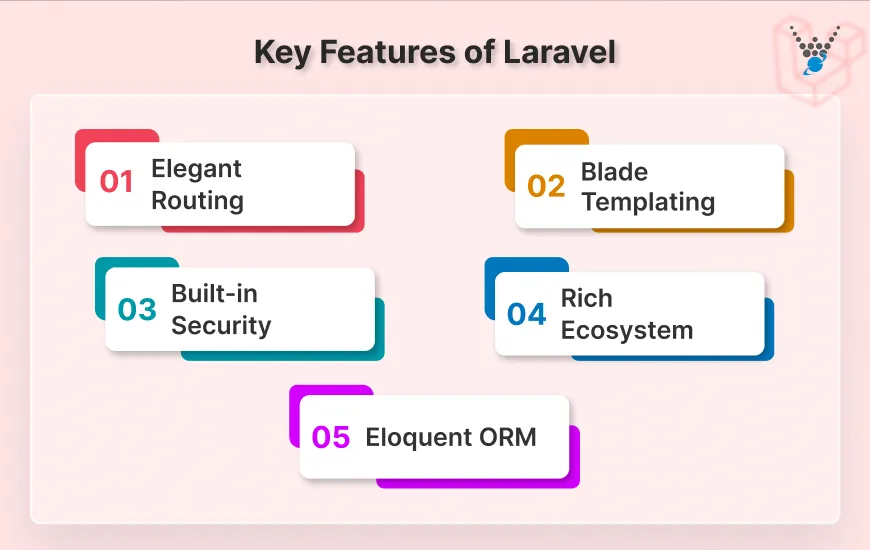
- Elegant routing: Clean URLs and clear paths for every page and action.
- Blade templating: Simple, readable views for layouts, emails, and front-end structure.
- Eloquent ORM: Smart, expressive way to work with databases without writing raw SQL each time.
- Built-in security: Tools for authentication, encryption, and protection against common attacks.
- Rich ecosystem: Queues, jobs, events, and packages that let your product grow without a rewrite.
In short, Laravel is a full-stack PHP framework that makes it simple to develop stable, feature-rich web applications. Its strengths include elegant routing, Blade templating, Eloquent ORM, built-in security, and a rich ecosystem for scalable development. If you’re ready to build with Laravel, hire Laravel developers to develop scalable applications.
Lumen Overview
Lumen is a lightweight PHP framework focused on speed and simplicity. It delivers data quickly, making it ideal for APIs and microservices. Lumen is different from full-featured frameworks because it only includes the essentials. This helps your application run with less overhead. Lumen is perfect for projects where performance is more important than full web features.
Key Features of Lumen
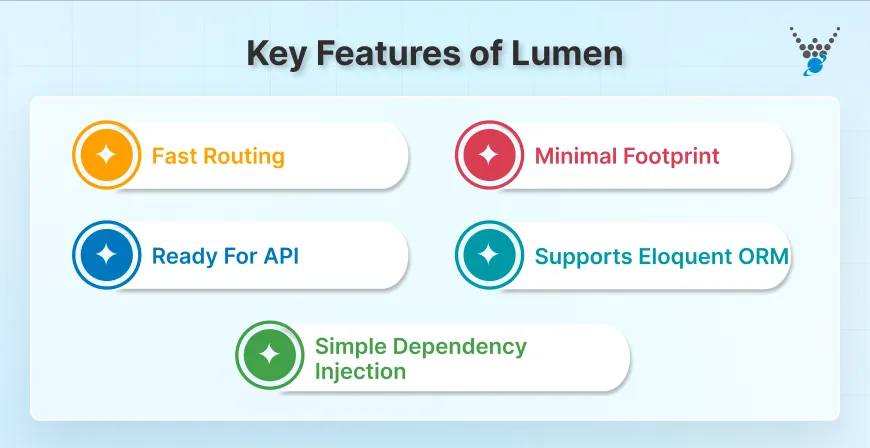
- Fast routing: Handles requests quickly without unnecessary processing.
- Minimal footprint: Lightweight structure keeps your app efficient.
- Simple dependency injection: Easy to manage services and components without extra complexity.
- Supports Eloquent ORM: Works with databases smoothly while staying fast.
- Ready for APIs: Built-in tools help with JSON responses, authentication, and routing. This makes it easy to create REST API services that respond quickly and consistently.
Simply put, Lumen is a fast PHP framework made for APIs and microservices. It focuses on the essentials to deliver data quickly. Its lightweight design, quick routing, and API-ready tools make it ideal for projects where performance matters more than full web features.
Comparing Lumen vs Laravel on Different Parameters
To choose between Lumen and Laravel, you need to align your project’s needs with each platform’s capabilities. The right framework provides a balance of speed, structure, and scalability.
Performance
- Lumen: Lumen is better for raw speed. Its stripped-down core and minimal middleware allow it to handle many requests with low overhead. Benchmarks usually show about 100 requests per second in common microservice setups. This makes Lumen one of the fastest PHP micro-frameworks.
- Laravel: Laravel is heavier by design. It loads additional features and middleware by default, increasing single-request overhead. For full web apps, this cost is reasonable. You gain features, better developer experience, and stability, but peak request throughput may suffer.
Architecture
- Lumen: Lumen uses the same MVC core as Laravel. However, it removes some heavier layers, like cookies and CSRF protection. This configuration maintains a clean and efficient architecture. It serves cases where minimal friction and quick execution matter more than full-feature depth.
- Laravel: It provides a complete architecture with all essential layers intact. It includes security features, session handling, and extensive tooling to support complex applications. This makes the architecture stronger and more capable, though heavier than Lumen’s minimal structure.
Response Time & Speed
- Lumen: Lumen responds faster because its micro-framework design keeps each request lightweight. It avoids heavy layers, allowing data to move through the system with minimal delay. This makes it ideal for high-speed APIs and services that require quick turnarounds.
- Laravel: It takes longer to respond because it loads more features with every request. Its full-stack nature adds overhead, though performance can improve with caching. It sacrifices raw speed for richer capabilities and a stronger structure.
Request Processing
- Lumen: Lumen keeps response times sharp and consistent. Its focus on routing and less middleware allows each request to move through the system quickly. This makes Lumen ideal when speed is the main priority.
- Laravel: Laravel manages a broader range of requests, including complex workflows and large RESTful APIs. This flexibility adds weight, so responses take a little longer. It excels when the application needs depth and structure more than pure speed.
Integration and Support
- Lumen: Lumen offers basic integration and relies on third-party tools for additional features. Its setup remains lightweight, but this also means more manual work when connecting external services. It suits small APIs where minimal integration is enough.
- Laravel: Laravel provides a more seamless integration across the PHP ecosystem. It works smoothly with packages, libraries, and community tools, offering developers much more support out of the box. This makes Laravel the better choice when you need dependable, well-maintained integrations.
Learning Curve
- Lumen: It is easy to understand because it has a simple structure. You can learn it quickly, making it great for beginners.
- Laravel: It takes more time because it offers a broader set of features and patterns. Once you understand its flow, it becomes powerful, but the initial learning curve is steeper than Lumen’s.
Lumen is a fast and lightweight option for simple, high-speed APIs. Laravel is a full-featured framework for complex, scalable applications. Pick Lumen for raw speed, and pick Laravel for power, structure, and long-term growth.
When to Use Laravel?
When choosing Laravel, consider the type of application you plan to build. The points below highlight situations where Laravel offers clear advantages.
- Full-Scale Web Applications: Laravel is ideal for projects that require complete web functionality. If your app needs user authentication, dashboards, admin panels, or multi-feature modules, Laravel provides a solid, structured foundation.
- Scalable Projects: If you plan to expand, Laravel’s architecture will provide stability and ease of maintenance. Its features, such as queues, caching, and events, help manage growing traffic and complex workflows without breaking the system.
- Feature-Rich Applications: Laravel includes built-in tools for security, routing, templating, and database management. If your project needs these features right away, Laravel saves development time. It also keeps your code clean and consistent.
- Standard and Structured Projects: Laravel enforces clear patterns, so it’s easier for teams to collaborate. Its conventions and MVC structure ensure that developers can work efficiently, even on large-scale projects.
- Community Support and Ecosystem: Laravel has a vast ecosystem and an active community. If your project requires packages, integrations, or long-term updates, Laravel provides reliable support and resources.
Choose Laravel when you need a full-featured and scalable framework. Best for complex, growing applications where stability, structure, and developer support matter more than raw speed. Partner with a trusted Laravel development company to build secure, scalable, and high-performance applications tailored to your business needs.
When to Use Lumen?
You find it easier to know the right use cases for Lumen once you understand the kind of projects it’s designed to support. The points below highlight where Lumen delivers the most practical value.
- High-Performance APIs: Lumen is built for speed. If your project needs to deliver data quickly, consider using Lumen. It is great for RESTful APIs and microservices. Lumen handles requests efficiently and with low overhead.
- Lightweight Applications: When you don’t need a full web framework with all the features, Lumen keeps only the essentials. Its slim structure ensures faster execution and a smaller footprint for lean applications.
- Small-Scale Projects: For projects that focus on a single task, Lumen is a great choice. It works well for things like authentication services, notifications, or API endpoints. Lumen provides a quick, easy, and effective solution.
- Speed Over Features: If you need a quick response time, Lumen is a good choice. Its simple design and focus on routing make it better than full-stack frameworks.
- Laravel Familiarity: Lumen shares Laravel’s core architecture. Teams familiar with Laravel can adopt Lumen quickly for lightweight services without learning an entirely new framework.
Use Lumen when performance, speed, and simplicity are priorities. It’s perfect for APIs, microservices, or small applications where minimal overhead and fast response times matter more than a full-featured ecosystem.
Other Backend Framework Comparison Guide:
ASP.NET Vs Laravel
Laravel Breeze Vs Jetstream Vs Fortify
CodeIgniter vs Laravel
Summing Up
Choosing between Laravel and Lumen depends on your project’s goals. For full-featured web applications that offer structure, stability, and a rich ecosystem, Laravel is the ideal choice. Lumen, on the other hand, excels in speed and simplicity. It is suitable for APIs, microservices, and projects where performance is critical.
Understanding their strengths will help you choose the right tool for your needs. If you’re unsure which framework best fits your project, feel free to reach out to us. Our experts will guide you on building fast, reliable, and scalable web applications.
FAQs on Laravel vs Lumen
Is Lumen faster than Laravel?
Yes, Lumen is much faster. It has a slimmer core and fewer layers, so each request moves quickly. Laravel has more features, which makes it take longer to respond. If you want speed for small APIs, Lumen feels quicker and more responsive in real use.
How to migrate from Lumen to Laravel?
Migration is simple but gradual. You move your routes, controllers, and models to a new Laravel setup. Then, you turn on the features that Lumen did not support. Most code carries over with little change because both frameworks share the same foundation. Once moved, you can start using Laravel’s broader tools and structure with ease.