

- Python excels in AI, data processing, automation, and high-concurrency APIs.
- PHP suits content websites, eCommerce stores, and database-driven web applications.
- Python prioritizes readability, flexibility, and a broad development ecosystem.
- PHP offers widespread hosting support and handles standard web requests efficiently.
- The right choice ultimately depends on your project’s workload and requirements.
A web application has two sides. The frontend is what people see and navigate in the browser. The backend stores data, checks logins, processes payments, and responds every time a user takes an action.
For a business, the language behind that frontend vs backend split decides two costs that never go away: how fast the team can ship updates, and what the application costs to run each year.
Few backend decisions are debated as often as Python vs PHP, and W3Techs‘ figures from September 2026 show how differently both languages are ranked:
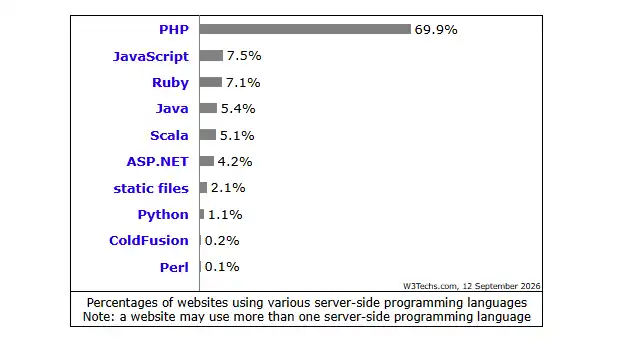
Source: W3Techs
Among developers, the ranking reverses. Python usage rose 7 percentage points in the 2025 Stack Overflow Developer Survey, and it ties that rise to AI, data science, and backend work. This gap between website share and developer demand is why the PHP vs Python choice needs to be revisited in 2026.
The difference between PHP and Python becomes clearer when you trace each language back to its original purpose.
Python Programming Language Explained
Guido van Rossum released Python in 1991, a few years before PHP, and designed it so developers could read code as easily as they write it.
CPython is the reference interpreter that compiles Python code into bytecode and runs it in a virtual machine on Windows, macOS, and Linux. This portability helped Python expand into web backends, data analysis, machine learning, and automation. For web development, Python relies mainly on Django, Flask, and FastAPI, and its latest version, Python 3.14, was released in October 2025.
Python Features That Shape Everyday Development
- Indentation-based syntax: Indentation, not curly braces, defines code blocks, so every file follows one visual structure and new developers can follow existing code quickly.
- Dynamic typing: Python variables don’t need declared types, but incompatible operations, like “5” + 10, raise a TypeError. Optional type hints can catch these issues earlier.
- Large standard library: Modules for files, JSON, HTTP, and testing ship with the language, and you can install third-party packages from PyPI through pip (Python’s default package installer).
- Per-project environments: The built-in venv module isolates each project, so applications on one server can use different library versions.
- Multiple programming styles: Procedural, object-oriented, and functional code can coexist in one codebase.
- Concurrency options: Python’s asyncio handles many I/O tasks, such as API calls and database queries, at the same time. Python 3.14 also officially supports a free-threaded build that can run multiple threads without the Global Interpreter Lock (GIL), though the standard build still uses the GIL.
Core Strengths of Python:
- Readable codebases: Developers joining mid-development understand existing modules easily, lowering the risk of errors during handovers.
- AI and data libraries: A Python backend can load a trained machine learning model and serve predictions without needing a second language in the stack.
- One language across services: One team can maintain the API, the data pipeline behind it, and the deployment scripts.
- Framework choice by project scope: Django includes an admin panel, an ORM, and authentication, while Flask and FastAPI offer a minimal core.
Limitations of Python:
- Slower execution: Pure Python can be slower than compiled languages, especially for CPU-heavy tasks. Libraries like NumPy improve performance by running intensive work in optimized compiled code.
- Restricted multi-core threading: The standard build’s GIL stops CPU-bound threads from running in parallel, so teams use multiple processes or the free-threaded build.
- Higher memory footprint: Python web apps run as long-lived processes that hold objects in memory between requests, demanding more memory than lower-level languages.
- Additional deployment layers: Web apps typically need a WSGI or ASGI server and may require more setup than traditional PHP hosting.
- Runtime type errors: Because Python is dynamically typed, type-related errors can appear at runtime unless caught earlier with type hints, testing, or static checking.
PHP was developed the other way, starting with web pages and adding general-purpose capabilities later.
PHP Scripting Language Explained
Rasmus Lerdorf created PHP in 1994 to add dynamic behavior to his personal website, and the name, first “Personal Home Page,” now means “PHP: Hypertext Preprocessor.” Its original purpose, inserting database content into HTML before a page reaches the browser, remains its core strength.
That purpose shaped PHP’s traditional shared-nothing model. In a standard PHP setup, each request runs the script, returns HTML or JSON, and then clears its request-specific memory. This model remains common across PHP-based websites and applications, and the latest version, PHP 8.5, was released on November 20, 2025.
PHP Features That Shape Everyday Development
- HTML embedding: PHP code embeds directly inside HTML templates, keeping data retrieval and presentation in one file.
- Extensive built-in functions: The PHP core offers over 1,000 functions for strings, arrays, dates, and sessions, while Python has 71 built-in functions and provides the rest in modules.
- Native database access: PHP’s PDO connects to MySQL, PostgreSQL, and SQLite. Its prepared statements keep SQL separate from user input to prevent SQL injection.
- Gradual typing: PHP converts types automatically, so “5” + 10 returns 15. Adding declare(strict_types=1) makes PHP reject mismatched types in typed function arguments and return values.
- OPcache and JIT compilation: OPcache keeps compiled bytecode in shared memory to skip parsing on repeat requests, and PHP 8.0 added a Just-In-Time (JIT) compiler for frequently executed code.
- Composer for dependencies: Composer installs packages from Packagist and locks exact versions for consistent deployments.
- Modern syntax: PHP 8.4 introduced property hooks, and PHP 8.5 added the pipe operator (|>), which passes a value through a chain of functions.
Core Strengths of PHP:
- Widely available hosting: Shared hosts, managed WordPress hosts, and cloud platforms run PHP without extra configuration, keeping infrastructure costs low.
- Fast delivery of database-driven pages: OPcache and the shared-nothing model keep page rendering quick and consistent during traffic spikes.
- Mature CMS and eCommerce ecosystem: Existing plugins cover payments, memberships, SEO, and shipping, minimizing custom development time.
- Enforced object visibility: The engine enforces private and protected properties, so external code cannot alter an object’s internal state.
Limitations of PHP:
- Inconsistent legacy functions: Older PHP functions don’t follow one argument order. For example, strpos() takes the haystack first, while in_array() takes the needle first.
- Silent type conversion: Without strict mode, automatic conversion can hide logic errors until they surface in production.
- Unsupported versions in production: Many PHP websites still run PHP 7, which no longer receives security patches.
- Limited data science tooling: PHP can connect to AI services through APIs, but it is rarely used for model training or large-scale data analysis.
- Extra runtimes for persistent connections: WebSockets and long-running jobs need runtimes like Swoole or RoadRunner, because standard PHP does not keep application state between requests.
A side-by-side view makes these differences easier to compare.
| Factors | Python | PHP |
|---|---|---|
| Language type | General-purpose | Server-side scripting for the web |
| First released | 1991 | 1995 (created in 1994) |
| Typing | Dynamic, runtime type enforcement, optional type hints | Dynamic, automatic type conversion, optional strict mode |
| Code blocks | Indentation | Curly braces and semicolons |
| Request model | Long-running process | Shared-nothing, fresh state per request |
| Standard web requests | Efficient with async frameworks | Very fast with OPcache |
| CPU-heavy and parallel work | Strong ecosystem for scientific, data, and ML workloads | Less suited to compute-intensive workloads |
| Main web frameworks | Django, Flask, FastAPI | Laravel, Symfony, CodeIgniter, CakePHP |
| Package manager | pip with PyPI | Composer with Packagist |
| Hosting | Application servers, containers, cloud platforms | Nearly all shared and managed hosts |
| Website share (W3Techs, 2026) | 1.1% | 69.9% |
| Best fit | APIs, data products, AI, automation | CMS, eCommerce, content sites |
| Latest release | 3.14 (October 2025) | 8.5 (November 2025) |
To understand the real impact of the difference between PHP and Python, here is a Reddit thread.
A Closer Look at The Differences Between Python and PHP
The Python vs PHP for web development question usually comes down to the five areas below.
Syntax, Readability, and Learning Curve
Python: Its code reads close to structured English, and mandatory indentation enforces a consistent layout. Many universities teach it first, including MIT’s introductory computer science course, built for students with little or no programming experience.
PHP: One script on a web server can generate a dynamic page, so learners see output early. Later in the development cycle of professional projects, add $-prefixed variables, brace-delimited blocks, and PHP-FIG coding standards (PSRs).
Speed and Performance Under Real Workloads
Benchmark results depend on the workload, which is why performance debates between Python vs PHP often reach opposite conclusions.
Python: The application stays in memory between requests, asynchronous frameworks hold thousands of connections open while waiting on databases or APIs, and C-based libraries handle heavy computation. An API that scores each request with a machine learning model suits Python.
PHP: Standard page requests are usually faster in PHP without tuning. OPcache removes repeated parsing, and PHP 7 ran up to twice as fast as PHP 5.6 in widely cited benchmarks, which suits a publishing site serving thousands of page views per minute.
Frameworks, Libraries, and Database Access
Python: Django is an all-in-one framework, while Flask and FastAPI let developers add only what they need. Python also has libraries for numerical computing and machine learning, with database access handled through SQLAlchemy or Django’s ORM.
PHP: Laravel and Symfony provide routing, templating, job queues, and an ORM, while PDO handles database connections from the core. Most PHP packages target web development needs like payments, email, and caching.
Interesting Read: Laravel vs CakePHP: Which PHP Framework to Choose for Web Development?
Interesting Read: Laravel vs CakePHP: Which PHP Framework to Choose for Web Development?
Security and Long-Term Support
Python: Django includes CSRF protection and parameterized database queries by default. Python releases receive about five years of support, including security updates.
PHP: Laravel provides CSRF protection and parameter binding, and the engine enforces private properties. Each release gets two years of active support plus two years of security fixes. Running unsupported PHP versions or outdated plugins can increase security risks.
Scalability, Hosting, and Deployment
Python: Apps run under a WSGI or ASGI server, usually in containers, giving teams more runtime control but requiring more DevOps effort.
PHP: Because no request depends on the previous one, PHP scales horizontally by adding servers behind a load balancer, and most hosts run it without extra configuration.
These differences point to clear cases where one language fits a project better.
When Python Is the Better Backend Choice
Python wins the Python vs PHP decision when the backend does more than serve pages, especially when data or AI drives the product.
- Products with AI features, including recommendation engines, document classification, and chatbots built on large language models.
- Analytics platforms and reporting dashboards that process large datasets.
- APIs that serve mobile apps and single-page frontends under heavy concurrent load.
- Automation, data scraping, and internal tools that share code with the main application.
- Development teams where data scientists and web developers share one language.
For a deeper understanding, explore the detailed review of how Python works for web development.
How Popular is Python Compared to Other Languages?
- Python ranks first on the TIOBE Index for September 2026 at 17.76%, well ahead of C at 10.28%.
- In the 2025 Stack Overflow survey, 57.9% of respondents reported extensive Python work, fourth behind JavaScript, HTML/CSS, and SQL.
- Among respondents learning to code, Python ranks first at 71.8%, signaling a growing pool of Python developers.
- Python is the most desired language in the same survey, with 39.3% of respondents wanting to use it next year.
- FastAPI, a Python framework for high-performance APIs, grew 5 percentage points, which Stack Overflow reads as a shift toward Python for fast APIs.
Interesting Read: NodeJS vs Python: Which Technology Is Right for You?
When PHP Is the More Practical Choice
PHP takes the lead in the PHP vs Python comparison when the project is a content-driven website, an online store, or an existing PHP codebase.
- Business websites, blogs, and publishing platforms on WordPress or Drupal, where editors depend on a mature admin interface.
- Online stores on WooCommerce or Magento that rely on established payment and shipping extensions.
- MVPs and small business web apps that must launch quickly on affordable hosting.
- Headless websites where editors keep managing content in WordPress or Drupal, so PHP remains the backend while a JavaScript frontend displays the content. This guide on headless CMS vs traditional CMS explains this setup in detail.
- Existing PHP applications that need modernization, where a rewrite would add cost without business value.
Real-world Adoption and Trends:
- As per W3Techs, WordPress runs 40.3% of all websites, and each depends on PHP, giving businesses a deep pool of developers, plugins, and hosts.
- PHP 8 powers 63.5% of PHP websites, showing that a large share of the ecosystem has moved to the actively supported PHP 8 generation.
- In the 2025 Stack Overflow survey, Laravel is used by 8.9% of respondents, above Symfony’s 4%, reflecting PHP’s role in custom applications beyond CMS platforms.
- PHP 8.5 gets security fixes until December 31, 2029, and PHP 8.6 is in beta for a November 2026 release, giving new projects a predictable upgrade path.
The final decision should therefore depend on workload, not popularity alone.
Final Verdict: Match the Language to the Workload
Asking which is better, PHP or Python, produces a useful answer only after the workload is clearly defined.
PHP remains the practical choice for content sites, eCommerce stores, and projects that need fast, affordable deployment. In any PHP vs Python for backend decision involving AI, analytics, or high-concurrency APIs, Python is the stronger choice because its libraries and asynchronous frameworks were designed for that work.
Many businesses run both, keeping the website on PHP and moving data or AI features into a Python service connected through an API. The web app vs website distinction helps here, as content-first websites lean toward PHP and data-driven web apps toward Python.
Frequently Asked Questions (FAQs)
Is PHP faster than Python for building websites?
Neither is universally faster. PHP performs well for traditional page-based websites, while Python’s asynchronous frameworks align with APIs that handle many concurrent I/O operations. Real-world performance depends on the framework, application logic, database, caching, and server configuration.
Which is easier for beginners, PHP or Python?
Python is generally easier to learn first, since its indentation-based syntax uses fewer symbols and reduces early mistakes. PHP is quicker when the goal is building or customizing WordPress sites.
Is PHP still worth learning in 2026?
Yes. PHP runs most websites as a known server-side language, and WordPress, WooCommerce, and Laravel depend on it, so demand stays steady for new builds and PHP 7 to PHP 8 upgrades.
Should an existing PHP website be rebuilt in Python?
Usually not. A rewrite adds cost and risk without improving content delivery. Upgrading to PHP 8.x and integrating a Python service for AI or data features reaches the same goal at lower cost.
Table of Contents